Episode Transcript
[00:00:00] Speaker A: This is let's Talk ms, the podcast.
[00:00:02] Speaker B: Of youth living with Ms. Let's Talk Ms.
[00:00:17] Speaker C: Welcome to let's Talk ms, a podcast series created by Young Minds for Young Minds and proudly brought to you by the European Multiple Sclerosis Platform. We are Elizabeth and Anna and we will be your hosts for today.
[00:00:29] Speaker D: In this podcast series, we are about to unpack the intricacies of living life as a young adult while navigating the challenges that come with multiple sclerosis, Ms. and related conditions such as an MOSD and MOGAD. From dating to nutrition or dealing with the Ms. Stigma, we are here to navigate it all through expert insights and personal stories.
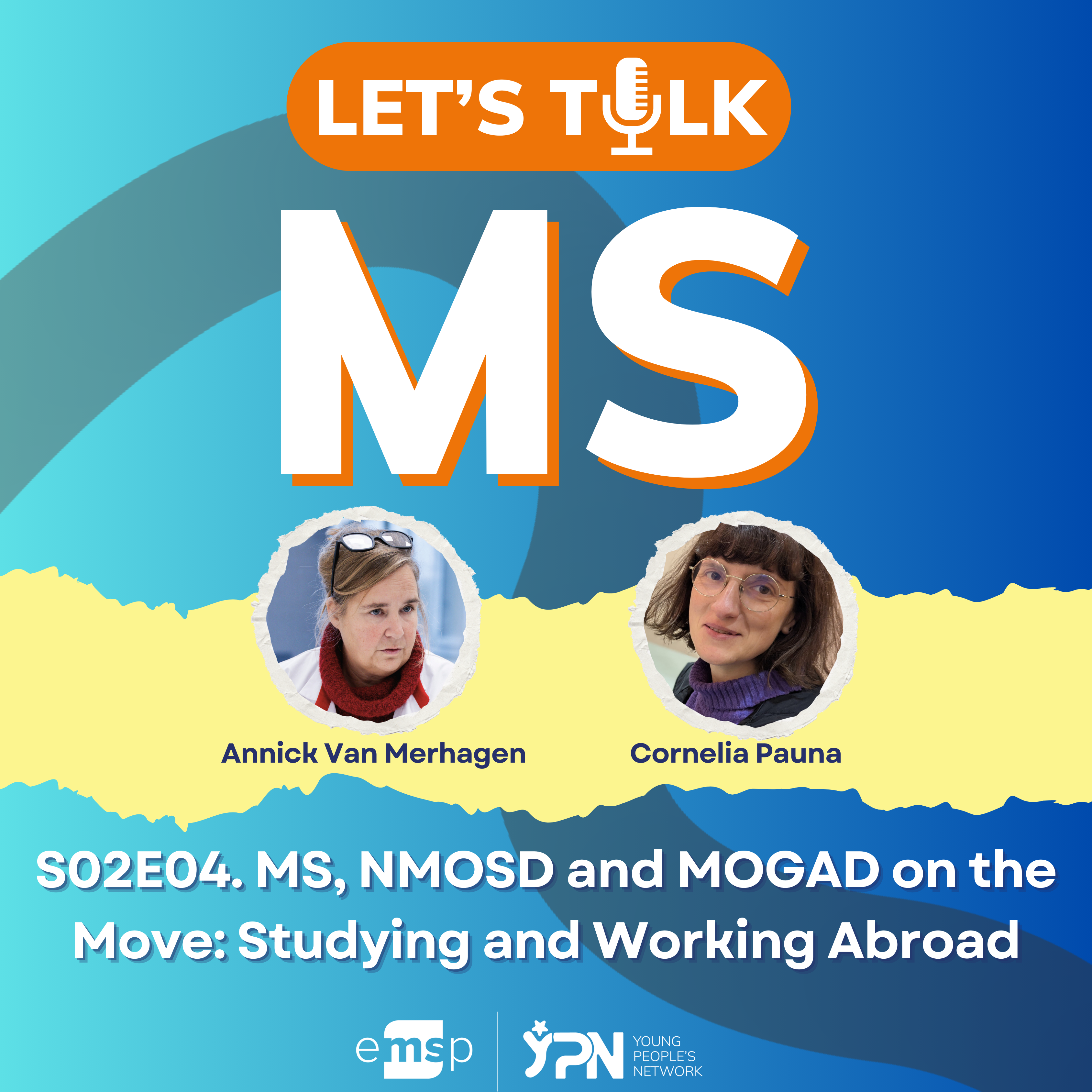
[00:00:51] Speaker C: In this episode, we will explore what it truly means to live abroad while managing a chronic condition such as ms, NMOSD or mogad. To dive into this topic, we are joined by Annik van Mer Glachan is a dedicated Ms. Nurse Specialist with over 15 years of experience at University Hospital in Brussels. Her practice is centered on patient consultation, nurse led care and collaboration with neurologists, always with a focus on holistic approach. She is deeply committed to understanding and addressing the lived experience of individuals with ms, advocating for comprehensive and patient centered care. Welcome Anik.
[00:01:27] Speaker B: Thank you.
[00:01:28] Speaker E: We will also welcome Cornelia Pauna, a YPN member from Romania diagnosed with Ms. Almost 10 years ago. Her diagnosis occurred shortly after the final year of her Bachelor of Studies and significantly influenced her early career decisions leading her to prioritize employment stability.
In 2025, she made the decision to return to academia in order to redirect her professional path. So today we hear what this decision meant for her and her Ms. Welcome Cornelio.
[00:02:00] Speaker A: Thank you. Happy to be here.
[00:02:02] Speaker E: For many young people, moving abroad, whether during their studies or once they have started their professional career, is always an option to consider.
How many people do you know who took part in an Erasmus program while at university?
Probably quite a few. And I'm sure we all know someone who decided to continue their professional path abroad for a short period of time or even independently.
Living abroad is often perceived as an exciting opportunity. A new country, a new language, a new culture, new friends. And of course it's an exacting opportunity. But we don't always talk about the challenges that come with this change, especially when you live with a chronic condition.
When you move abroad, you don't leave everything behind. You do not leave your chronic condition behind. You take it with you and you have to learn how to adapt it in a completely new environment with new healthcare systems, new administrative procedures and new ways of ACCESSING SUPPORT the topic today is about moving abroad. However, this situation can also happen when moving between regions within your own country.
As a person living with multiple sclerosis myself, who moved from Spain to Belgium two years ago, I understand very well why many people decide not to move.
Actually, I have asked myself many times, why did I do this to myself? Why didn't I just stay in my city where I already knew the system, the doctors, and had all the supports and facilities I needed.
[00:03:32] Speaker D: Thank you for the introduction on the topic. It's really important and your experience also moving into a new city and discovering new things is exciting, but there is that burden of living with chronic conditions and also try to seek the right support, the right system to live in. And I'm going to turn to our expert guest here today. Annik. You probably meet a lot of patients from different backgrounds that have moved from different countries. So can you tell us a little bit what are the first challenge that the people are facing when they come into a new healthcare system and what they need to be aware of?
[00:04:09] Speaker B: Yes, of course. I think there's all the hustle of the paperwork and let's say the bureaucratic systems that you. You have to handle. It's not always that easy to.
To find your way. We have like organizations in hospital or there's a service in hospital at University Hospital in Brussels. But there's Ms. League, which is a patient organization, who you can turn to. But I think that you have to reach out yourself and it's not always so easy to find your way when you come into a new country. Taking into account there's a lot of things that you have to manage at the same time.
[00:04:50] Speaker D: Indeed, I think it's a good point that maybe we end something we hear actually quite often is like there is not enough signposting towards the patient. Organizations that can help navigate the new systems and provide basic information for people that are affected. So that's something we could also reflect with the healthcare professionals how to implement more systematic sign posting or information. So for the patients to get to the information they need. And from your experience, what are the questions that come more often from the patients who have recently moved? Is it about access to care, treatment continuity? Because from one country to another it's different. The reimbursement system might be different. Language is a barrier. So what are the most frequent questions that comes up from the.
[00:05:37] Speaker B: Yes, exactly. How can I continue having my necessary care? What to do in case of emergency? It's a very important question, I think. How can I handle that where to turn to, who to turn to.
We also have. Well, in the Belgian situation, with access to primary caregivers, there's a lot of shortage in general practitioners, for example, so that's not always an easy way. I think these are the most important.
Yes, reimbursement of course is also important, but in my opinion, it was certainly, if you come from within the European Union, it wasn't that difficult to obtain the reimbursement from the Belgium Social Security system.
[00:06:27] Speaker D: And you were saying about the continuity of care.
So is it usually, is there a system where the data from another country can be retrieved or is it something expected from the patients themselves?
[00:06:41] Speaker B: My experience we had like the treating neurologists, the original one in the original country, reaching out to us. So sometime, or maybe the patient that sent an email, I'm going to live for a while in your country, how can we manage the exchange? But there is no platform in which to exchange medical information internationally. Actually within the country there is, but not within Europe or maybe even further, not yet.
[00:07:11] Speaker D: Indeed, that's a long process, probably a goal that.
[00:07:15] Speaker B: Yes, I can imagine in Europe, but.
[00:07:18] Speaker D: So there is still a little burden there on the patients also to know what to do and to approach. And we know that consultation time with neurologists can be very short. So discussing all this can be also a challenge. Another point that you are mentioning about the emergency care, in case of emergency, what would you recommend to the patients if they didn't have time to already connect, get to know the healthcare system or even identify. Identify a treating neurologist or a center? What should they do?
[00:07:47] Speaker B: Yes, I think the first step, if it's possible, is address a general practitioner. But it's not always so easy to manage. So I think if you don't have access to anyone, then it would be fine to turn yourself to an emergency department at the hospital nearby. So they will always be able to manage. It's quite accessible. So I think like an Ms. Relapse is considered as an emergency, actually. So that should be fine if you walk in and mention what you're suffering from. So they won't send you away without doing anything.
[00:08:25] Speaker D: Yeah, but I think as a general recommendation, maybe.
And then Cornelia could maybe look in answer that. But would that be recommended first to when you arrive in a new country that you know you're going to stay for a little while. That first step should also to proactively look for the healthcare professionals and kind of settle that instead of waiting for any longer. I think that would be a good Approach?
[00:08:50] Speaker A: No, yeah, definitely that was my case. When I arrived in Spain, I just tried to contact the patient organization from that region and I looked for hospitals that could take care of any type of emergencies. But then they from the organization, they also told me the steps that I would need to do in case of such situation.
This gave me a peace of mind, you know, in case of something I know what I need to do. So definitely it's a good point.
[00:09:18] Speaker B: Yeah.
[00:09:19] Speaker C: In that case, patient organizations are really helpful when you are lost and you don't know where to start. It's always good if you can reach out to the regional or national Ms. Or patient organization that is in the area. In my case I felt really lost that I didn't know how to do. And actually I had to feel like now that I work for emsp, if anyone comes and tells me that they moved to Belgium, what would I do? And then I was like, ah, I would tell them to speak with the Belgian League. And I was like, why didn't I think this before? So I had to thought as if anyone else was coming to me. So that's what, that's also what I did to find out the neurologist. But Cornelia, could you briefly share with us what this return to academia meant for you and your ms? And because we know that you are moving around different countries for the coming years.
[00:10:08] Speaker A: Yeah, I applied for this master that every semester I will be in a different country. Country which I mean, it took me a while to take this decision, especially because of this logistics and being outside my comfort zone. But I think it was, to be honest, the best decision I could make because I was feeling stuck in my career path, I didn't feel very happy and this influenced the rest of my life. So it was something I had to do for my well being. In the end, although it's a bit more work to do because of this logistics situations, I still feel that it was the best decision.
[00:10:48] Speaker C: It's good that you were brave to take this decision and now you see that it was a really good one. But how challenging is to plan your medication or your doctor appointments?
[00:10:59] Speaker A: Yeah, indeed it was quite difficult because there were things outside my control like, I don't know, the schedule of my classes or my academic commitments ahead of time. So some of them I had to guess and gamble to be honest. I just assume that they were in this period so I could schedule my appointments in outside that period. And if anything happened, I would just say that hey, this is something I need to do. So people are Usually understand. They understand the situation, so that's good. And other than that, I don't think I had any other. It was just more like in my head, like if something happens, what I need to do, that was more time consuming and energy consuming.
[00:11:45] Speaker D: Yeah.
[00:11:45] Speaker C: Actually now what you meant is like one of the results of the project that EMSP presented last year that it's called Impact of Ms.
[00:11:54] Speaker E: Symptoms.
[00:11:55] Speaker C: One of the final statements was that usually patients, we need to create our.
[00:11:59] Speaker E: Own system instead of the system being created for patients.
[00:12:02] Speaker C: So what you mentioned now it really remind me that sometimes we have a lot of mental pressure or workload on our own because we need to manage everything and that's not that helpful in these situations. But in your case, are you still going back to Romania for your medication?
[00:12:18] Speaker A: Yes, in the end I decided to keep my treatment in Romania. It's just because I need to change the country every six months. So sometimes it takes quite some time to enroll in the national treatment plan in the other countries. And by the time I managed to do that, I finished my treatment, I already had. So. And then I need to change again the country and go again through the process, which is really time consuming. And my idea was to have a strategy that would have the less impact on my fatigue and my mental health. And I thought it's way easier to travel back to Romania, especially because at least Spain and Belgium is quite well connected to Romania. However, when I will arrive in Finland, I would probably try to get into their system because it's quite difficult to come from there to here. And it will imply I will get more tired and I don't want death. You know, it's the conservation instinct totally.
[00:13:15] Speaker C: We need to take care of ourselves and avoid this traveling and more when it's closer to the medication, I feel. So, Anik, coming back to you, what kind of support systems or accommodations can students or employees with Ms. NMOSD or Mograd request when they are studying or working abroad?
[00:13:33] Speaker B: Well, I was just wondering about what Cornelia said. Maybe I come back to what she said. But is there any instance from your university that can help you in, I don't know, accommodating you in finding some healthcare professionals or. I don't know, does that exist? Because I had the idea that here at university in Brussels there was some kind of service that supports, especially exchange students in this kind of matters.
[00:14:06] Speaker A: I didn't go that far in a sense. I just talked to the person that is managing my master. I asked for help in case of emergency, explaining my situation and he gave me some solutions, but I didn't go further the line just because I knew I will, you know, go back to my country. So I. For things that I would need. So.
[00:14:27] Speaker B: Yeah, yeah, but, yeah, but I think it depends on the treatment that you're having. I can imagine if it's something that you're having like twice a year, it's easier to just don't go through all the, the paperwork and the hassle. So. Yes, I can imagine. Yeah, yeah, I'm sorry, Anna.
[00:14:43] Speaker D: Yes. Nice to know actually that there is such a. That there could be such a service provided by the university for people to know when they are looking for information that they. There's also the possibility of looking at the patient organization, but when preparing to talk with the universities to do a little bit of background check of what is available in kind of service information services in the country of origin and in the country where they're aiming for. And the university might have already received so many of those questions before and they should be able to help. I have a question regarding the psychological support, because that is also something that would be important. Right. And the language might be also an issue because we always feel more comfortable speaking in our mother tongue and sharing in our mother tongue specifically when we are in this type of therapy. So here I think, is there any recommendations on how the people can work still with the specialists they are working from their home countries? Or is it. Do you think that it would be easy to find people that speak different languages in the country where you are heading to? I don't know. It is in Belgium. I don't know if the psychologists are speaking different languages. Probably. Yes.
[00:15:58] Speaker B: Well, in Brussels we all have to speak like Dutch and French, but most people also speak English because we also have a big expat community as like NATO and the European Community is settled here in Brussels. So I think maybe we are a bit exceptional at that point of view. But we also have a service within the hospital and I think it's mandatory in Flanders or maybe in the entirety of Belgium to have like this intercultural negotiator or mediator is a better word.
So people can request someone who is familiar or comes from their country of origin or is familiar with, to assist them with the consultation itself. So can act as a translator, but. But it's often not only like just language, but also the cultural background that can be taken into account. Of course, if you request like a psychological support, well, there's like this third person that assists you. It's not always that comfortable. I can imagine. While these persons are of course they're mostly like health care professionals that work in the hospital, so they also need to comply to like medical privacy.
But of course, yes, it's not always that comfortable to have like this third party that is. That is there. Yeah, yeah.
[00:17:24] Speaker D: But it's already helpful, I guess, like one step towards the right direction and to at least give some alternative when you are stuck. It's always good.
[00:17:33] Speaker B: Yes, yeah, yeah, exactly.
[00:17:35] Speaker C: I think I feel that this language barrier is. It can be super stressing for people with Ms. And msdmo. Knowing that, or at least some. It was something that really stressed me, the idea of going to the neurologist and not speaking my case Catalan. I was like, how will I explain my symptoms or my condition in general? So it's great that the hospital has this support system.
[00:18:00] Speaker B: Yes, exactly. But I think also in a medical context. Well, I think if you have like this informal conversations with your friends or with other students, it's like easier to talk. Talk in not your native language, but in a medical context you have to find your words. Can you imagine? There's also this emotional aspect that's not always so easy to express, especially in another language. I mean, I'm even Dutch speaking.
Well, like French comes easily to me, so it's like my second language, but my native language is Dutch. So I often feel like it's not always so easy to. To express something emotional towards a French speaking person. And the other way around too. So that's also a different level. I think you can do your best to speak the language, but there are some things that you can't express, I think, or are difficult to express in another language.
[00:18:55] Speaker D: Speaking about communication and talking about your disease is something that come to mind. And maybe for Cornelia first, when you were moving or already engaging with your university, was that difficult for you to disclose about your diagnosis?
Did you feel any. That there will be any repercussion in the reaction of the university or the service that they will provide? Were you open to that discussion?
[00:19:22] Speaker A: I disclosed up front that I have Ms. And on one side I did that because I didn't feel like there would be repercussions in my old job. I told them after a few years because at the beginning I was afraid to tell them. I received a positive reaction from them and I realized I had no reason to be afraid of that. So I went with that mindset at the university.
And on the other side I knew that there will be a chance for me to maintain my treatment in Romania, which meant that I will need to travel during weekdays back. So I would miss maybe classes. And I just wanted them to know that I'm not missing for the sake of missing like traveling. I don't know, it was just because I need to do that. So these were the two main motivations for me and I really didn't have any thoughts that they will judge me or something like that.
[00:20:13] Speaker D: Would that be a recommendations for the young people that are considering to be really clear what other needs are and that everyone can work with them on this or Because I know that there are many people that will be thinking and maybe overthinking about disclosing, talking about the conditions and the reaction that people can have on this.
[00:20:34] Speaker A: Yeah, definitely. I recommend being honest is just that if you're not. Not honest with this, it would mean that for instance, when you have fatigue, then you would have either to pretend that you're okay, which is bad for you.
[00:20:49] Speaker E: Yeah.
[00:20:49] Speaker A: Long term, I think it's more harmful for you to pretend that you don't.
[00:20:54] Speaker D: Have anything in terms of managing with the fatigue and the cognitive fog and so on. Do you have any tips that you could give to our audience?
[00:21:04] Speaker A: For me, it was really helpful to do reality checks. I would say either spoon theory or energy balance. I've learned a lot about energy balance this semester, so I'm now always referencing that. It's just that if you know that you have a lot of things that take a lot of energy from you, then you might need to sacrifice some things. So for instance, I would decide not to go out or I don't know, party or something just to rest and also to stop whenever I would feel that my body is too stressed.
[00:21:40] Speaker D: That's a great advice. And I think we can put a link to some reference on these theories for our listener so they can check it out because those are really good tools to manage your fatigue. But Anique, maybe from your side, can you tell us maybe what kind of guidance you would offer to someone who feels anxious about leaving their home countries due to their Ms. Diagnosis? And like, how would you. If you see that the patients come to. To you with a bit of anxiety, thinking like I'm not able.
How would you. What would be your recommendation to them?
[00:22:12] Speaker B: I would always recommend to do it first thing. So just to live your life even with ms, Go ahead. You just, it's. It's manageable, you can do it. But I think preparation is key. And also don't be afraid or ashamed to reach out to, I don't know the country where you're heading to just to inform yourself already check which hospitals are nearby, maybe reach out to the Ms. Nurse or the patient organization.
So a lot of people are a bit afraid of things they don't know.
So if you have it already a bit under control or there has been already a bit of contact, it should be fine. I had like two Erasmus exchange students, I think one from Italy, the other one was from maybe even Australia who reached out. It was super to have them. And like the first weekend she sent an email, oh, I have a cold. What do I have to do? We never saw each other just by mail.
So it was really nice. Nice to be able to support these people too. It's like my mother hand instinct that showed up. But it was. No, it was really nice. Just don't be afraid to do it. It will reassure you a bit to who to turn to. And there's always some easy contact points. It should be fine. Yes.
[00:23:31] Speaker D: And from your experience, do you think that living abroad can help empower people with Ms. In boost their confidence? Confidence?
[00:23:38] Speaker B: Yes, absolutely. Absolutely. I think it's very important for especially young people to not let them be taken aback by their disease and just go for it. Go for it and have lead a normal life as normal as possible within the limits. And so yes, yes, I think it's. It's very important just to. To grab that opportunity.
[00:24:01] Speaker D: Yeah, I really like that. And what my take from, from what you're saying, like the. I love it. Just. Just do it first of all. Yeah, to do it, Go for it.
The preparation is key. Those make sure that you get the information you need and don't hesitate to ask all the professionals you encounter, they are there for that purpose to help.
So they will be able to guide you in the right direction. And if not, reach out to the patients organization, to the healthcare professionals information centers in your universities and so on. Our employers. If you are going abroad for work, but don't hesitate to reach out, like what could be the worst? They're not going to answer. They won't have time to answer. But if you don't do it, you will never know. So just go for it. Exactly. That's a very good point.
[00:24:48] Speaker C: Yeah. And Cornelia, what did living with the world teach you about yourself and about your ms? Because I'm sure you have learned many things during these past months.
[00:24:58] Speaker A: Oh yeah, definitely.
First of all, I think I've learned that I'm more resilient than I thought I am. Am. And that I actually have the tools to overcome an obstacle in a crisis, either on my own or by asking for help that I can self regulate if I take the time. And I also learned to pay more attention to my needs because when I was in my bubble at home, I felt that if anything happens I had my close ones, I had my healthcare providers in the nearby, so I'm safe, right? But being alone in another country, I just want to prevent urgencies. So I learned to do, as I said earlier, more reality checks and really listen to my body.
[00:25:40] Speaker C: That's incredible. And it's something we should all learn to do it, even if we stay in our hometowns or home countries. And sometimes life is so fast that we just don't pay attention to these things when they are super important. And Cornelia, one last question. If someone from the Young People's network came to you telling that they are thinking or that think about moving abroad and they are not sure because of their ms, NMOSD or mogad, what would be your advice?
[00:26:08] Speaker A: I'm not so good with advices, but I was also hesitant in taking the decision because my mind was searching for all the reasons I shouldn't do. So. I would say that if you're comfortable but having a desire that's not yet fulfilled and you're searching for all the reasons not to do it, then check if, if it's the fear talking, like if you remove the fear, what would you do?
[00:26:33] Speaker C: Thank you for these really powerful messages today in this conversation. And yeah, hopefully they will help to someone listening to us that are thinking the possibility of moving abroad. Personally, I think that what Danik said that if you are thinking about doing this step, just do it because it will bring you many positive things. Of course it will be challenges and sometimes during the process you will feel that maybe it was not the best decision. But then with time you will see that of course it was a great decision and you are always allowed to go back home, that it's not a permanent decision. So it can be temporary, permanent, whatever you feel most comfortable. So yeah, just do it.
Elizabeth, I don't know if you would like to add any final remarks.
[00:27:18] Speaker D: No, I think it's great to have this conversation and I invite really everyone to keep the conversation going. Doing, when you are even thinking about doing something, always have. As we were saying before, expert advice and not just overthinking and getting into your own anxiety and bubble and close up. It's really important that you talk with your peers, talk with people that are going through the same things, find those forums and Turn to your healthcare professionals that are there to help you to go through those decisions. And family and friends also are really important. So when you're settling in a new country, keep in touch with your family and friends.
Now we can do everything online, so it's quite nice to always have the support system following you. Something we didn't touch upon here, but I think the support system is really key and something we could maybe discuss during one of our next podcasts. How to do that. Even if you're not close to them physically, it's important that they're there. I know that Adna has a little game prepare for our guest speakers now. A rapid fire game. So ADNA will let you lead on this.
[00:28:28] Speaker C: Perfect. It's really simple, Gabe. It's a rapid fire Q and I, so you only need to answer with the first thing that pops up in your mind. Okay, so first question. Early bird or night owl?
[00:28:40] Speaker A: Early bird.
[00:28:41] Speaker B: Early birds.
[00:28:42] Speaker D: Yeah, I also turned early bird recently.
[00:28:45] Speaker C: Me too.
So team of early birds. That's good.
Routine or spontaneity?
[00:28:51] Speaker A: Both. A little bit of both, yes.
[00:28:53] Speaker B: I would reply the same thing.
[00:28:57] Speaker D: It's have your routine but keep your spontaneity.
[00:29:02] Speaker A: Opportunity.
[00:29:02] Speaker D: I like that.
[00:29:04] Speaker C: I also like that. But I. I need to say that I feel that with my ms, my symptoms are more under control when I have routine. That when I don't have routine and I don't have like good routine of sleeping or eating, doing a sport, then I don't feel that well.
[00:29:19] Speaker A: So yeah, yeah, I agree totally with you.
[00:29:22] Speaker C: But it's also nice to have spontaneity. So next question. Comfort food or try new food?
[00:29:27] Speaker A: Try new food. Healthy, preferably.
[00:29:34] Speaker B: Yes. While trying new food. But comfort food is always an occasional option, I think. Yes.
[00:29:44] Speaker C: And for you, Elizabeth, comfort food.
[00:29:46] Speaker D: I think I'm not really into trying new food, but maybe one day I will open.
[00:29:52] Speaker C: I like to try new food, but not when it's a spicy or hot. Then I prefer comfort food to really enjoy of food. So next one. Staying or moving?
[00:30:02] Speaker A: Moving.
[00:30:03] Speaker B: Moving, yes.
[00:30:05] Speaker D: Yeah, definitely moving. We should try new things, new places. And.
[00:30:10] Speaker C: And one last question. Tips to explain your condition to a person you have recently met in another language.
[00:30:16] Speaker B: That requires some overthinking, I think.
[00:30:20] Speaker A: Yes. Not rapid.
[00:30:25] Speaker B: Yes. I think the advice that I can give is be open about it with the means that you have to express yourself or to explain yourself. I think it's communication is key. Yes.
[00:30:38] Speaker A: Yeah, I would second that. Like be honest with your needs to yourself and to the others.
[00:30:44] Speaker B: Absolutely. Yeah.
[00:30:45] Speaker D: And maybe Just an advice when you know in which country you are going to just have a little like prepare. Preparation is key. As you were saying, prepare a little summary that you can learn in the language so that you know how to explain.
We had that once that someone was here in Belgium to call the emergency and the ambulance. They came and they didn't really understand each other. So it would be nice to have a pre prepared summary of your condition so in case you're not able to communicate or that you have difficulties with the language, at least you can share in return. So that could be helpful to always have with you in case you're not certain of yourself or not confident in enough yet. But just a little tip because we had had this situation and it was nice that I happened to be there to do the translation, but I could see that if I was not there that person would have been struggling.
[00:31:41] Speaker C: And as I I would also like to add one advice and is that sometimes when you meet people you don't need to tell them that you have.
[00:31:48] Speaker E: A chronic condition if you don't feel.
[00:31:50] Speaker C: Comfortable to to do so. So I mean I always like to disclose my condition and to explain it, but then there are occasions that it's like now I don't feel comfortable starting this conversation. So it's also okay if you don't want to start the conversation and it might come with time or it might not come. So I think that's another from my point of view, good advice.
So unfortunately we are at the end of our episode and that wraps up.
[00:32:15] Speaker E: This episode of let's Talk Ms. Thank you to Annika and Cornelia for sharing your experiences and expertise on this topic. Hopefully this episode will encourage someone living with Ms. And or MOGAD thinking about this change in their life to take action and move. Just do it. Trust on the process. It might be challenging, but at the end it will be worth it. Don't hesitate to reach out to patient organizations locally and ask for support and guidance as well as looking for a general practitioner in your new country.
[00:32:46] Speaker C: If you enjoyed this episode, please share it with your peers, friends and family. Don't forget to subscribe to our podcast channel to stay updated on upcoming episodes. In our next episode we will be talking about nutrition, another important topic for the Ms. NMOSD and MAGAD community. You can also follow us on Instagram and Twitter. UMS Youth. Thank you so much for listening today and until next time.
[00:33:18] Speaker D: Sat.