Episode Transcript
[00:00:00] Speaker A: This is let's talk ms, the podcast of youth living with Ms. Let's talk
[00:00:05] Speaker B: Ms.
[00:00:08] Speaker A: Let's talk Ms.
Let's talk Ms.
[00:00:17] Speaker C: Hello everyone and welcome back. We are happy you are joining us for the third season of let's Talk Ms. Podcast with fresh topics and new perspectives.
Whether you've been with us from the beginning or this is your first episode, thank you for joining us. Now let's get started. Relationships, career goals, mental health, living with Multiple Sclerosis and msd.
Nothing is off the table. Real life, real conversations. You are listening to let's Talk ms, brought to you by the European Multiple Sclerosis Platform. We are your hosts, Elisabethe and Nana. We are here to chat with Young People and experts about what life is really like with these conditions.
From everyday challenges and practical advice to personal stories, resilience, and everything in between. Because whatever you are facing, you are not facing it alone. This is our story, our community.
So let's talk.
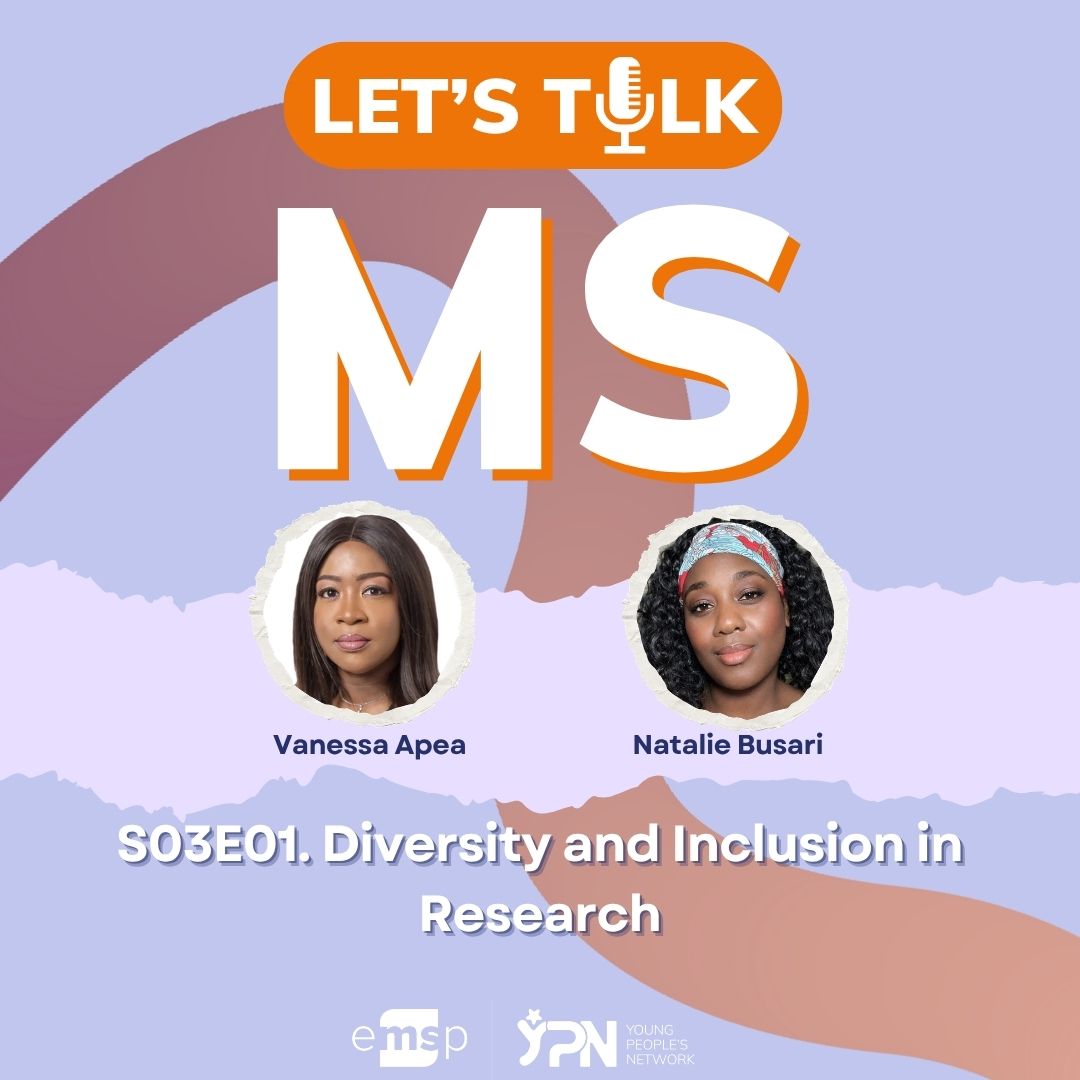
[00:01:08] Speaker D: In today's episode, we will be addressing the question of inclusion and diversity in research, an issue which is often ignored or not taken seriously, but which has an impact on the care of people. Why does it matter who is often left behind? How can we build studies that truly reflect our real communities? Those are the questions we will try to answer today and we are glad to welcome two special guests with us. The first one, Natalie Busuri, is the founder and CEO of the Nerve of My Multiple Sclerosis. She's been diagnosed with Ms. 10 years ago and she's now an international patient advocate committee to supporting the black people and other underrepresented communities affected by Ms. And MOSD and MOGAD And we also have Vanessa Baer, a consultant physician with over 20 years of clinical experience who is Deputy Academic Lead for Equality, Diversity and Inclusion at the Queen Mary University of London. Thank you very much for joining us today. It's really a pleasure to have you with us.
[00:02:11] Speaker C: To set the scene, it's important to highlight a fundamental fact. Many communities remain underrepresented in the health and social sectors, more so in research. People excluded or marginalized because of their race, ethnicity, disability, sexual orientation, gender identity, socioeconomic background often feel unheard. This has real consequences for their health outcomes and not in a positive way. To better understand the importance of this conversation, let's start with some facts and figures. Non Hispanic Black people with Ms. Have the highest mortality rate among people younger
[00:02:43] Speaker E: than 55 years relative to other racial groups with Ms.
[00:02:48] Speaker C: Evidence indicates that Black people with Ms. Experience more severe disease at baseline, including
[00:02:53] Speaker E: higher expanded disability Status scale scores, a
[00:02:57] Speaker C: diagnosis and 5 year follow up. Black people with Ms. May experience faster clinical progression and poorer clinical outcomes than white people with MS, including shorter median time to needing a cane. Evidence indicates that black people with Ms. Might have different responses to specific disease modifying treatment.
[00:03:15] Speaker D: Thank you. Thank you Anna for sharing those stats. And I would like to start with maybe a question for Vanessa. Having worked in the research field for more than 20 years, can you tell us a little bit what from your perspective, where do we currently stand when it comes to inclusion and diversity in research?
[00:03:33] Speaker B: Thank you so much. I think that, you know, I always say that diversity in research is not a nice to have. It's part of scientific quality and if the people in the study don't reflect the people who use the evidence, then the evidence is complete. And what I can definitely see over the past number of years is that we have made progress in talking about inclusion and diversity. But the reality is that many studies do not reflect the populations that are most affected by the condition being studied. So we often continue to see underrepresentation by race, ethnicity, age, gender, ability, you know, language, socioeconomic status. I can go on. And so we have seen progress. We have seen people creating more, more spaces to talk about it and consider it, but it is not enough. And we really need to understand that. In many areas of medicine we've built evidence from a really narrow evidence base and population and then we've applied it really broadly and that creates blind spots. So a lot has been done, but a lot more to do.
[00:04:52] Speaker D: Thank you for this. And indeed it's not a nice to have. I think that's a very, very clear message and I think we kind of not say it enough because I feel like it's bec. Check the box. Diversity and inclusion. Diversity and inclusion. Everyone is talking about it, but in terms of action, sometimes it's more for to show that you're doing something rather than to take real actions. So it's really nice that we have to remind that to the people on things. Do you think that the lack of representation beyond affecting the quality and the outcomes of the research, does it have a longer term impact in terms of the sustainability of the system that we are building?
[00:05:32] Speaker B: Completely, because sustainability requires trust. You have to trust the evidence that comes out. You have to trust that what you have been told to do and action.
As someone living with any condition, you have to trust the information that you're given. And so if you don't trust where it came from, you're less likely to trust the advice given and to follow it up. And in addition to that, sustainability in terms of a system in which we talk about things but then we don't action it, it becomes very unstable because we need to embed what we talk about for sustainability.
And sadly that still isn't the case. So I think, as you say, many points along the chain in which sustainability is at risk. Definitely thank you for this.
[00:06:24] Speaker D: And I have a bit provocative question as a follow up also because I come the Asian community. Right. But do you think that our communities are vocal enough to say that we are not well represented? Do you think that our communities have the space in the different fora to be able to speak up and say that we are not represented?
[00:06:47] Speaker B: I don't think many communities. So, you know, being a black woman myself and being of, you know, Ghanaian and African heritage, I know that a number of people in the community that I work with and engage with, many are not aware of what is possible to be involved in. You know, so you, if you have to advocate a lobby, you need to know what you're lobbying for and you need the language to fit the people you're trying to change as well. And so there are so many divides. And what frustrates me though is that there's an assumption that, you know, and again, I'm being really, really broad and generic, but just for the conversation that, you know, many black communities are cautious of research and don't want to get involved and would never want to get involved and things like that.
And that is far from the case. But if you haven't been included in the conversation and you don't fully understand what you're advocating for, then how are you going to fight for it? You know, and the lack of trust in which some of the decision making is made by some communities is really fair enough.
What we've done to date has not been fair and inclusive. So I think that you're right and it's not really provocative.
I think we need to be more provocative.
Communities are not pushing because they haven't been included in the fight as much as they should have been. But what I am loving is that because more of the conversation is getting out there, then you are seeing a shift and you are getting people asking where is the data coming from? What does it say? How can we be involved? And if they don't want to be involved, they're also articulating why they don't want to be involved. And that is really important as well.
[00:08:33] Speaker E: Thanks for sharing this, Vanessa. And I feel that Nathalie you have a role in this shift that we are seeing, that the Network of My Ms. Is a nonprofit representing the black community, individuals living with Ms. And MSD and MOGAD, combating cultural stigmas.
So for you, as a founder of this community, what was the motivation behind the creation and what impact did you want to achieve?
[00:08:58] Speaker A: It's quite a strange one because I didn't intend to, you know, be a founder of a nonprofit. It just started off with me advocating for myself.
I was diagnosed with Multiple Sclerosis in 2016, just two months after giving birth to my second child.
And the leaflets and all the things they told me that I needed to do, the medication, all the imagery were just like white ethnicity.
I felt like there was nothing there that said black people have this disease. So at first, I was even questioning my own neurologist if she's made a mistake, because I checked up online. They always tell you, don't look online, but you're going to look online anyway.
And it was just. I felt really lonely about it. And I asked my neurologist, you know, is there more information about black people living with Multiple Sclerosis? She said there's. There's not that many here in Europe, but she gave me a few kind of articles in the US because apparently they've done more information on that research on that, but it just wasn't enough for me. And so when I started advocating, I was a little bit rebellious with it because I come from a, like, Vanessa Ghanaian family and a lot of my aunties, I always mentioned this particular auntie, but she no long speaks to me because she wanted me not to talk about my illness. She didn't want me to go to a neurologist. And she said that the fact that I went to a neurologist means I don't trust God to fix it. So I think. And other relatives are more like, oh, we don't want people to know about it. You know, keep it to yourself. God will deal with it. And it's just like, I was always religious, I'm still religious, but it was more like, how am I coping with it? I need somebody to, you know, help me along this kind of journey. And I did the. The most open thing.
And I went on social media and I told everybody that I had Multiple Sclerosis. And I just kind of talked about my journey. I didn't hold back times where even. I think one time I was actually going through a relapse. And I was recording it because I wanted people to know what it's like. Living with this disease, there's a lot of people in the community would message me, they'll come forward. And I started seeing more black people coming forward saying they're going through the same things.
You know, I can't believe you're speaking so openly about it and encouraged speak about it, which made more people want to speak about it. And I think it was just the fear of knowing that you're not the only one talking about it. And the more and more people started coming forward, then I realized that it was way bigger than me when I started listening to their stories. Some were saying they were dismissed. Some were saying that, you know, doctors kind of dismissed their early symptoms as growing pains. You know, the stories just kept coming back, and Young People, older people kept coming from, you know, black heritage backgrounds, and they're all saying the same things. And I was thinking, there's more to this, and there's definitely. It goes beyond me. So I decided that I think it was my mom and a few other people, and a friend of a family told me, why don't you just, you know, do a charity or cic, something like that, so that you can. Because everything was coming out of my own pocket when I was doing little kind of like meetings and gatherings and stuff. And my mom was just like, you can't do this. You have to do something that brings some money in so that you can, you know, help look after this community. So I registered as a CIC with a few of my friends from school and from friends of the family, and then know the nerve of my Ms. Was born. And we just started advocating from there. And I don't know how it's happened, but it's kind of like it could have just mainly been me just always being curious. But I, I, when I was going to all these conferences, I would never see a lot of black people at these Ms. Conferences. And I find it so strange. And I would then, you know, start trying to get the community to come to these conferences. Some didn't want to do it. Some just said they didn't feel comfortable and things like that. So it just started building on from there. And then I spoke to researchers, European researchers, and they were saying that they doubt there's any Ms. In African countries. And that made me more curious because I wanted to know a bit more. So I started talking to doctors and neurologists in Ghana, and I made a trip to Ghana to meet some of them, but unfortunately I was very sick, so I had to cut the trip short. But I kept in contact with Some of the doctors and they said there's very much. The case is was, you know, increasing. I think they were concentrating on NMO in Ghana. And then so when they started counting the numbers, they realized there was a much more of an increase in Ms. So I stayed in contact with them and I said, we need to do something in Ghana. And then I started looking in Nigeria and I realized it was the same thing. So I wanted to have, like a base, build up a team in Ghana, build up a team in Nigeria, because I'm from Ghana, so I had family to help there. And then I started getting ambassadors who were interested. And then it just. Then we had the nerve of my Miss Ghana, just, I think last year in the nerve of my Miss Nigeria. And then I'm sitting here like, how did I get. How did we get here from just me? And now I realize there's a need for it, you know, because when I was doing my events in the uk, like, I'm based in South London, but then when I was looking at the forms to see who was attending, the people from Scotland attending our events, people from Ireland, Wales and all across the country come all the way down just to my small little events in London. And then I realized that there was a need for it. So then it just started growing from there, and it was still kind of navigating because we are a small team and we're just trying to build this large demand at the same time.
[00:14:09] Speaker E: But that's great, everything you've achieved so far. So congrats on this from what you've said. I have two questions just for one short answer. Because we need to focus on research as the episode is on research. Although I want to know everything. But if Natalie was diagnosed today, how different would be the situation today?
[00:14:27] Speaker A: Oh, I don't know. That one is a strange one because, like, if I was diagnosed today, thinking
[00:14:33] Speaker E: about, like, the kind that at the time you felt alone, like there was no information on black community, that I guess that that would be quite different,
[00:14:42] Speaker A: I think, because there's more awareness of it now.
So I think maybe.
I think it would be a bit better. I think it'll be less lonely because we're more. We're talking about it more. So I think definitely more of the advocacy, more boldness, because I think people are a bit more into their shells in our community, but I think a lot of the younger generation are coming out more and speaking about it more. So I would be definitely much less lonely.
[00:15:07] Speaker E: That's important.
And from your. Have you ever been invited to participate in any kind of research.
[00:15:13] Speaker A: And if, or not really, my neurologist kind of asked me if I could, if she could have my permission to I think, go into my medical records. And she wanted to use that to compare with other patients. So I think that's what some people forget, that they think it always is clinical, it's not always the case. I mean, the ADAM study, I was invited to do that as well. And that one looks. I was more interested in that one because it looks more Asian, Asian and black ancestry. So that one is simple as just getting your saliva sample, putting it into the post. They get like a little package, tells you how to use it and everything. Usually like a sample put it in the post and then it's added to their database and then they start to. I think they've already started doing research on it already. So I've encouraged a lot of people in the community to go to the ADAM study so that as well. But I think when I had the stem cell transplant, it's kind of stabilized my Ms. So I'm not like most people who are still on treatment that kind of like do most of these trial. But any opportunity I get where I can get involved in research, definitely. So at the moment I'm on the Ms. Register UK and I've done the ADAM study and also that research that my neurologist asked me for, that's great.
[00:16:21] Speaker E: I mean to when possible to be involved. So, Elizabeth, back to you.
[00:16:26] Speaker D: Now that we are looking into those challenges and barriers, I guess, of involving the different communities.
And that's a question, I guess, a little bit for both of you. But in terms of the barriers that you think that the minorities are facing, do you feel that there is like some common barriers and what would be the way to overcome those? And also what do you think would make people hesitate to take part in research we've learned, like when I was asking earlier, like, are we vocal enough?
But it's also, are we aware enough that there are those studies and that we can take part in those studies? Do you think that there are challenges that we as a community can help overcome?
[00:17:10] Speaker B: So I think that there are many challenges that would be very relevant for many different communities. And for me, I always think of just the practical barriers that matter enormously and often get overlooked. And that relates to the fact that one of the biggest challenges for inclusion is that it's often considered too late. So it's added at the recruitment stage when the protocol, the sites, the language, the payment model and eligibility criteria have Already excluded people, you know, so you're already starting on the back foot anyway and you haven't thought about the practical stuff. And it's basic stuff, human stuff, like time off work, childcare, transport, language, immigration concerns. We assume that everyone is happy to be seen in their full glory, you know, and many people are living under the radar and so the fact that they've come to hospital does not mean that they feel comfortable for you to even know their full name. And so you have that digital exclusion and, you know, something that Natalie said, like, completely resonates in my life. I don't know if it's been Gillian, but I'm sure it's not. It's just, you know, is that family members as well, you may think that, okay, it's fine to talk about where you are in life and fine to access treatment. And then you tell family members, they're already annoyed and saying that you're, you know, betraying God, you're not protecting yourself. And then on top of that you're going to make yourself a guinea pig for research. And at that point they're like, you know, absolutely not. And so you've got so many different barriers, internal, structural, social, that I think really, really impact. And then, you know, coming back again to trust, there's so much variable trust and levels of trust. And I think that I always say to my colleagues, trust can't be built with a flyer. You know, it's got to be built with relationships, transparency and accountability. And you know, I mentioned payment models as well. It is really difficult to pay people appropriately. And so you speak to people and you say that you're going to give them vouchers and what vouchers are you going to give them? Are they ones that they can actually use? And if you're going to give people money, sometimes that can affect other support they're getting as well from the government. I'm using the UK as an example. So when you're actually considering if people want to get involved and how you can support them to stay involved, you have to think of all these things. And I think that, you know, we need to be honest about institutions, research often rewards, speed, recruitment targets, publications, etc. And more than the long term relationship building, community accountability and you know, that long term engagement as well.
[00:19:58] Speaker D: Thank you, Vanessa. I think that's really important. And one thing when you, what you're speaking on, because that also resonated with me, like some of the things that you are saying in the setting we are in and the cultural differences, but There is one thing I'm thinking, like, is that something we can start early at an educational level now that also when we look at different generations within the minorities, how can we help the future generation to build the messaging and transfer that messaging towards the senior people? That could be something that could be also a solution in terms of how can we be more inclusive by educating also at a younger age about research and making sure the message is across already when we are learning things, because I don't think we see that enough.
[00:20:47] Speaker B: I completely agree. And I also think we need to go steps further as well as supporting more people from our backgrounds to be leading the research, you know, to get involved in science and the progress of science. Because I think representation across all aspects, well, it's of all aspects of life, really, isn't it? But we're talking about research here, and it shouldn't be that you see, you know, black people just taking part. You want to see black people at all levels of the research being part of it, designing it, delivering it, and being part of it as well. And I think you're right that education needs to start early, but it needs to be a broad education about how do we really get involved and how do we change things. And to change things, we need to be in it.
[00:21:38] Speaker D: And concretely, if we were to change the world, what would be the steps that you would take and what could be the concrete example of steps that you would recommend for people to do and to make that shift? Keep going.
[00:21:54] Speaker B: A big, big, bold question. So.
So first of all, I would say that, you know, it's that thing that we hear more and more, and again, we don't do enough about it. So we, we say that we need to move from asking, you know, why are communities hard to reach? And then we need to ask, why has our research team been hard for communities to access? You know, we talk about changing that mindset, but I think that that is the crux of it. So we, we've got to be really bold and intentional about making that shift and making research more accessible to people and research teams really reconstructing their systems for communities. So, you know, that's what I would say. I.
I think, you know, when I think of how it can be done and how it can be done well, what I use is often use this example, it's not because I was involved in the study, I'm saying it was done well, but it's a study that I really loved being a part of. I think it worked really well in making sure that people were engaged about it. And so it was a HIV study so supporting people living with HIV and it was about delivering long acting injectable HIV treatments.
And what was really important there is that we were really intentional from the beginning as to who was going to be involved and the eligibility for the study. So we made sure we had certain levels that we had to achieve in terms of ethnicity and race, in terms of age and in terms of gender. And that put a whole different light on how we were approaching the study. Because if from the very beginning it was non negotiable that we were going to have at least 30, 30% of black people in it or from racially minoritized groups, we had to do it. So how are we going to get those groups in? We had to change our recruitment, we had to change our engagement, we had to change who was part of the community advisory board, all of that. And then we were also challenged all the time. So when we thought that we were doing something that would work, someone in the board would say no, you can't go past go unless you've changed this part of the protocol to move forward.
So I think that approach for me is what I would really say. Bold and intentional inclusion from the start and really for systems to change and not expect people to change.
[00:24:25] Speaker D: Thank you, Vanessa. This is really, really nice to hear that you know those steps need to be strong steps and from the get go. But I have a follow up question that's for maybe for Natalia also to reflect on is like when we are talking that and something that Vanessa just mentioned, like why are our communities so hard to.
I mean if we're not speaking in the right forum already that's like you're not going to get to those people.
But we now are doing the exercises, patients organization to translate the science towards the patients so that it's accessible, that it's shared in a language that they can really understand and get involved more meaningfully and so on, do you feel that there should be also a translation towards the specific communities?
And do you think that it will help not just to share what we will generally share towards all the patients? And do you feel that there should be another level of translating the science towards the communities?
Would that help?
[00:25:29] Speaker A: For example, if I think about the Adams study, that one and I think there was another one, I can't remember their name and they were talking about fatigue in Ms. I can't remember what that study was called but they were very much intentional about, about it being for underrepresented like ethnic groups like Asians and black heritage communities.
So when it's those ones, I've noticed that what Vanessa was saying, they're very much intentional in looking for it, but I think the problem lies with the overall ones. So, for example, with the Ms. Society UK's Octopus trial or the Chariot Ms. Trial, it's open for those who are eligible. But it's like how you get to black communities, you have to be very intentional all the time. Because when I was in a few meetings, consultation meetings, about the same thing, how do we be more inclusive? It was more like, oh, should we put more posters up in the clinics and stuff. And I had to explain that if someone from a black community is coming in there, they're going for their appointment and they're in the waiting room and they'll probably see the leaflets, but they won't be intentional to go up and actually pick that up and then take it home, even ask questions. There's been times where I've seen some research studies, clinical research studies, and I have asked people in my community, oh, this is happening, you know, and let them know more information about it. And some of them were keen to go and I thought, oh, job done. I've managed to get some of the community in there, but what I didn't realize is that the work hadn't finished yet. When they were in there, the language broke down. I think one lady in particular told me that when she was in there, they were very much talking in scientific terms, the jargon. It worried them because they didn't understand, okay, what are the risks and stuff. And I think she was saying that the way they were talking, she said, I'm sorry, can you say that again? Sorry? And she felt bad having to keep saying that. So unfortunately, she left. She didn't give much of a reason why, but when she spoke to me, she said she was very much concerned that she didn't feel like they were talking to her on a level playing field. And she. And she felt a bit worried. So I was thinking like, okay, so it's going to take a bit more than me just signposting, you know, the community there, inside. The researchers have to understand there needs to be that cultural sensitivity. You have to make sure that you're speaking on their level and the language is clear, clear. So I was working with a few researchers from Queen. I think it's Queen Mary about how to have that cultural sensitivity. So sometimes I do participate in those things as well. So it does help the community. But what I found is that the community seems More comfortable when we're talking together and we're speaking together and then signposting. So these, you know, researchers organizations need to work with grassroots organizations like us. So because we're the ones who speak on that level playing field and will speak for the them, advocate for them as well. So to be honest with you, my own self, when I started, I kind of judged it on how my family was. So when I was doing my first event, I didn't think anyone would actually turn up to talk about illnesses. We just don't do that, you know, just openly and freely. But the amount of people that came in and were talking, they actually did want to take part. And I was a little bit shocked as well that also you do want to get involved in clinical research. They said they do, but they don't know where to go. Where do they hear about this? And when I'm, because I'm obviously in the community, I speak to people from white backgrounds and they're just like, oh, I just went to, to a.
I just tried this trial out the other day. I just went here. They have, they seem more informed about it. They can talk about it. Nowhere to go. But people within my community don't know much about it, but they do Follow large charities, Ms. charities that do signpost it. But I feel like there's a gap. I don't know whether it's just like the trust. They do want to go, but there needs to be that connect. And I think it's, you know, the researchers, the language there, the trust. And one of the things that I've noticed as well, and I did tell researchers, I don't blame them too much, but they're in that same kind of category as medical. Anything medical. You have to understand that you've really got to work for that trust because if they're. They don't see their own people there, there's going to be that kind of nervousness. I don't trust, but I do want to take part. But if I'm. I don't want to be the first and only one to be taken part. So there's a lot of work to be done in that area, but I think we can achieve it. I think there just needs to be that kind of between the, the grassroots organizations, the researchers and put in the patients as part of the whole process coming together kind of thing.
[00:29:45] Speaker E: Thanks for sharing, Nadine. I think that everyone like grass organizations like Ms. Organizations, research as hospital, we have homework and there are many things that we can improve. And I have to say that you mentioned the cultural sensitivity. I have never put a name to this concept and I think that's really interesting and something that maybe also for that emsp on people's network we could try to disseminate it more and learn more about the importance. And also here I just take the moment to share with you that at the MSP we have the Young People Network. It's our network of Young People with
[00:30:17] Speaker C: Ms. And MSD and MOGAD.
[00:30:18] Speaker E: If you know anyone or if anyone is listening to us, you are more than welcome to join the network. And we want everyone to feel comfortable. It would be amazing to have different backgrounds also for the members to better understand the different situations at the end it gives us like reaches point of view of how we live with a condition. So thanks for sharing like both perspectives. I think that for people listening that's really interesting to understand that. I mean for me, for example, everything you share, maybe I've not been that involved in research as I have Ms. Myself, but I haven't been that involved in research. So everything that you were saying was super interesting and it just brought me many thoughts. And I think that I will keep reflecting on this during the following, following days and weeks.
But yeah, unfortunately we are arriving to the end of the episode as we need to be mindful of the time.
[00:31:10] Speaker D: Thank you very much. And I just wanted to share maybe my takeaway message from this. Thank you very much, Vanessa and Natalie too for being with us and sharing your own experiences.
But just to remind people, as you were saying before, Vanessa, it's not nice to have and we will keep pushing to have more, but in a more meaningful way.
And it's important that we start to work collaboratively together with the science committee, the research community and the patient community together to make sure that we have a bigger impact and that the shift is really meaningful and it's not a tick the box exercise. And I feel that sometimes people are afraid right there. They're afraid. They think that this is the biggest challenge to reach out to the different communities. Communities. I would like to say it's not that challenging if you know where you have to speak to find the ambassadors of those communities to go there. But also not to speak only in our own forums because what you are describing here, Natalie, when you are saying like they don't know where to go, sign posting is not enough because the sign posting or the information is shared on dedicated channels only, whereas it can be shared in different environments. And I'm still thinking when we're looking at the Young People, they're connecting in so many other forums.
Why not have this educational process also awareness in other forums. We have to stop working in silos and making it a niche. This is general information and if we want more people, more communities to be involved, we need to be out there. So anyone that can help with that messaging would be great. And we welcome everyone to collaborate with us so we can make this community come together and work together. So that will be my really my takeaway from this. So thank you very much for this, Anna. Back to you.
[00:33:01] Speaker E: Perfect. Thank you, Lisa. And before we go, we have a small release, more game for the two of you. So it's really simple. I will start with a sentence and then each of you have to complete the title with a word or a short sentence. Okay?
[00:33:15] Speaker C: So the first one is inclusion in research is non negotiable.
[00:33:19] Speaker A: Must be intentional.
[00:33:21] Speaker C: Second one, the biggest barrier is there's so many.
[00:33:24] Speaker A: I'll probably say, I'll say trust. I would say, yeah, research design.
[00:33:30] Speaker E: The future of research looks like.
[00:33:32] Speaker B: I was going to say, like, yeah, the future of research looks like. I'm trying to find out the right words for that because I was thinking that it designs before it measures. But the future of research looks like it needs to look. Looks like it should look.
[00:33:48] Speaker C: And that wraps up this episode of let's Talk Ms. Thank you to Vanessa and Natalie for sharing your experiences and expertise on this topic. We want to have a meaningful shift in inclusion and diversity driven research. So from EMSP and hopefully together with our community we will work towards this goal. If you enjoyed this episode, don't hesitate to share it with your peers, friends and family.
[00:34:09] Speaker E: And subscribe to our podcast channel to
[00:34:11] Speaker C: stay updated on upcoming episodes. In our next episode, we will be talking about the use of AI in healthcare, another important topic for our community. You can also follow us on Instagram and Twitter @UMSU. Thank you so much much for listening today. Until next time, bye.